Posts

Showing posts with the label Constitution

Cultural Heritage of India | Handicraft | Art of Weaving, Embroidery and Leather Industry

Art of  Weaving and Embroidery           Ancient India had a unique place in the fields of hand weaving, embroidery and knitting. It was said that the whole piece of cloth of a particular size (Taka) of fine muslin of Dhaka could easily pass through a ring and could be adjusted in a matchbox. Moreover 'Galicha' (carpet of several regions), knitting work on attires and artistry etc. occupied a prominent place. Amongst them are Patola of Patan (Gujarat), Bandhani of Rajasthan, kanjivaram saree and kashmiri cloth having 'Kasab' work .           During the golden period of Solanki era, Gujarat had progressed in this field. During the reign of Siddhraj Jaisingh many artisans (weavers) came and settled in Patan and made the town world famous, especially for its Patola. Some weavers of Patan were the best artists particularly of Patola of Patan. This art of Patan is more than 850 years old. Only a handful people have the skill...
What is meant by Fundamental Rights And Directive Principles Of State Policy?

Fundamental Rights (Part III ART - 12-32) What is meant by Fundamental Rights? Influenced by French Declaration of Rights, bill of right of  American constitution, UDHR. Fundamental Rights are guaranteed by the constitution to all persons without ant discrimination. Generally, Rights can be classified into              1. Moral Right                2. Legal Right             3. Fundamental Right For Part - 1, Please click the below link >> Text Classification Of Fundamental Rights How many Fundamental Rights are there? Originally, the constitution provided 7 fundamental rights, i.e.  1 RIGHT TO EQUALITY  ART - 14-18   2 RIGHT TO FREEDOM  ART - 19-22   3 RIGHT AGAINST EXPLOITATION  ART - 23-24   4 FREEDOM OF RELIGION  ART - 25-28   5 CULTURAL & EDUCATION RIGHTS  ART - 29-30...

Reasons For The Outbreak Of The Revolt Of 1857 C.E. In India

What are the reason for the outbreak of the revolt of 1857 C.E. in India?           The main reasons for the revolt of 1857 C.E. was the widespread dissatisfaction among the people in India due to the suppressive policies of the British adopted to spread their empire in India.  Social and religious reasons           The Policy of Social Reforms by the Company made people feel insecure and suspicious. They felt that the government was trying to convert them to Christianity and destroy the Indian culture and religion forever. People believed that the Indian social system was deliberately undermined in the railways, jails and military. A larger section of our society was orthodox at that time and thus, the new changes arouse dissatisfaction in them. As a result, many people joined this freedom movement to sustain their socio-religious structure. Economic reasons           The aim of the Brit...

Human Rights In India | Protection Of Human Rights

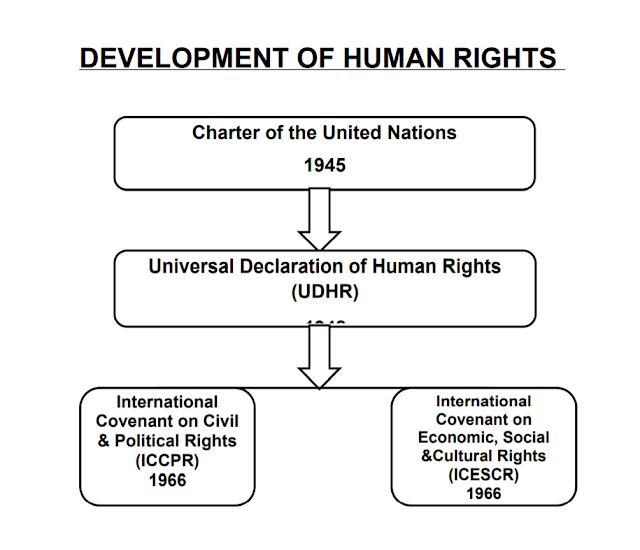
The Nations undertook the responsibility to preserve, secure, protect & defend the Human Rights and Freedoms of their People. The adoption of Universal Declaration of Human Rights by the United Nations General Assembly in 1948 very much had an impact on the making of the Indian Constitution. PROTECTION OF HUMAN RIGHTS PROTECTION OF HUMAN RIGHTS ACTS, 1933 The Secretariat in the Memorandum Supervision & Enforcement of Human Rights in 1947 had suggested for the creation of such body in the States. In 1966, the General Assembly adopted a resolution for the creation of a National Commission on Human Rights to perform certain functions pertaining on Human Rights. In 1970, the Commission establishment of the National Commission on Human Rights should be decided by each Government in the light of traditions and institutions of its own Country. The Human Rights Commission Bill was introduced in the Lok Sabha on 14th May 1992. The President of India on 27th September 1993 Promulgated an...

Human Rights | Concept And Development Of Human Rights

Image
What is Human Rights? Human Rights are those rights which are enjoyed by an individual as a Human Being. These are basic and inalienable rights. Every individual possesses and enjoys those rights irrespective of his/her Caste, Colour, Sex, Race, Religion etc. Thus, it is equally available to all aliens, refugees, minorities etc. which makes them Universal in Nature. Human Rights are the equally available to all aliens, refugees, minorities etc. which makes them Universal in Nature. Human Rights are the basic foundation of a Democratic Society. Human Rights are a Set of Universal Principles which seek to ensure the equal worth of each individual life, applicable to all people at all times and in all places. DEVELOPMENT & SCOPE OF HUMAN RIGHTS Importance of  Human Rights The origin of human rights is as old as History. The Ancient Greek City-State, have provided Freedom of Speech, Equality Before Law, Right to vote and so on. The Roman law also provided for similar rights to the ...

UNION & STATE EXECUTIVE

UNION EXECUTIVE T he union executive comprises the President, Prime Minister & the Council of Ministers President assumes as ‘ORNAMENTAL  POSITION’ He is called the “NOMINAL EXECUTIVE” The day to day administration is carried out by the Council of Minister - the ‘REAL EXECUTIVE’ PRESIDENT Art 52 to 78 in Part V deal with the union executive The President is the Head of the Indian State He is the first citizen of India, act as the symbol of unity, integrity of the nation According to Art 52, there shall be a President of India. The executive power of the union is rested (given) to him  Art 53 – he shall exercise such powers either directly or through the officers sub – ordinate to him  NOTE >>> 44th Amendment Act, the powers of President and made him to act on the advice of the council of Minister Art 54 - ELECTION OF PRESIDENT President is elected indirectly by an electoral college consisting of   Members of RajyaSabha & elected members of LokSa...